Reverse logistics is everything that happens when a product travels back from the customer: the return request, the trip back, the inspection, and the decision to restock, refurbish, return, recycle or dispose of it. This quick guide walks through the process step by step, with a diagram, and shows how to make it faster and cheaper.
Returns have increased in frequency with the development of e-commerce and are worth almost a trillion dollars globally each year. Compared to at least 30% of items ordered online, less than 10% of in-store purchases are returned. Smart businesses employ reverse logistics to increase client retention and repeat business operations while reducing return-related losses.
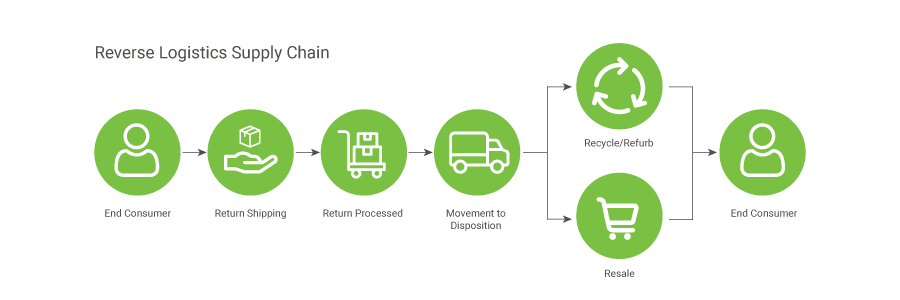
Reverse logistics is a crucial component of supply chain management that successful supply chain companies use to carry out operations effectively and boost value for their end customers. Organizations use reverse logistics when goods return from their destination back through the supply chain to the seller and possibly back to the suppliers through processes like returns or recycling.
Successful reverse logistics aims to maintain product circularity so that production, distribution, shipping, delivery, returns, repairs, and disposal may all continue to line up as parts of an efficiency model that is always spinning. This process does not only cut costs for businesses, and subsequently for their clients and end users, but it also lessens the number of things that wind up in our landfills. Your company may provide value for its clients by demonstrating how it manages these necessary procedures by creating and implementing a strong reverse logistics plan.
Optimized reverse logistics also leads to better supply chain visibility, which leads to benefits like:
- Cost reduction
- Greater customer satisfaction
- Better customer retention
- Faster and better service
- Loss reduction
- Improved brand sentiment
- Waste reduction and greater sustainability
Understanding the various types of reverse logistics helps you implement efficient processes and reduce costs.
The reverse logistics process, step by step
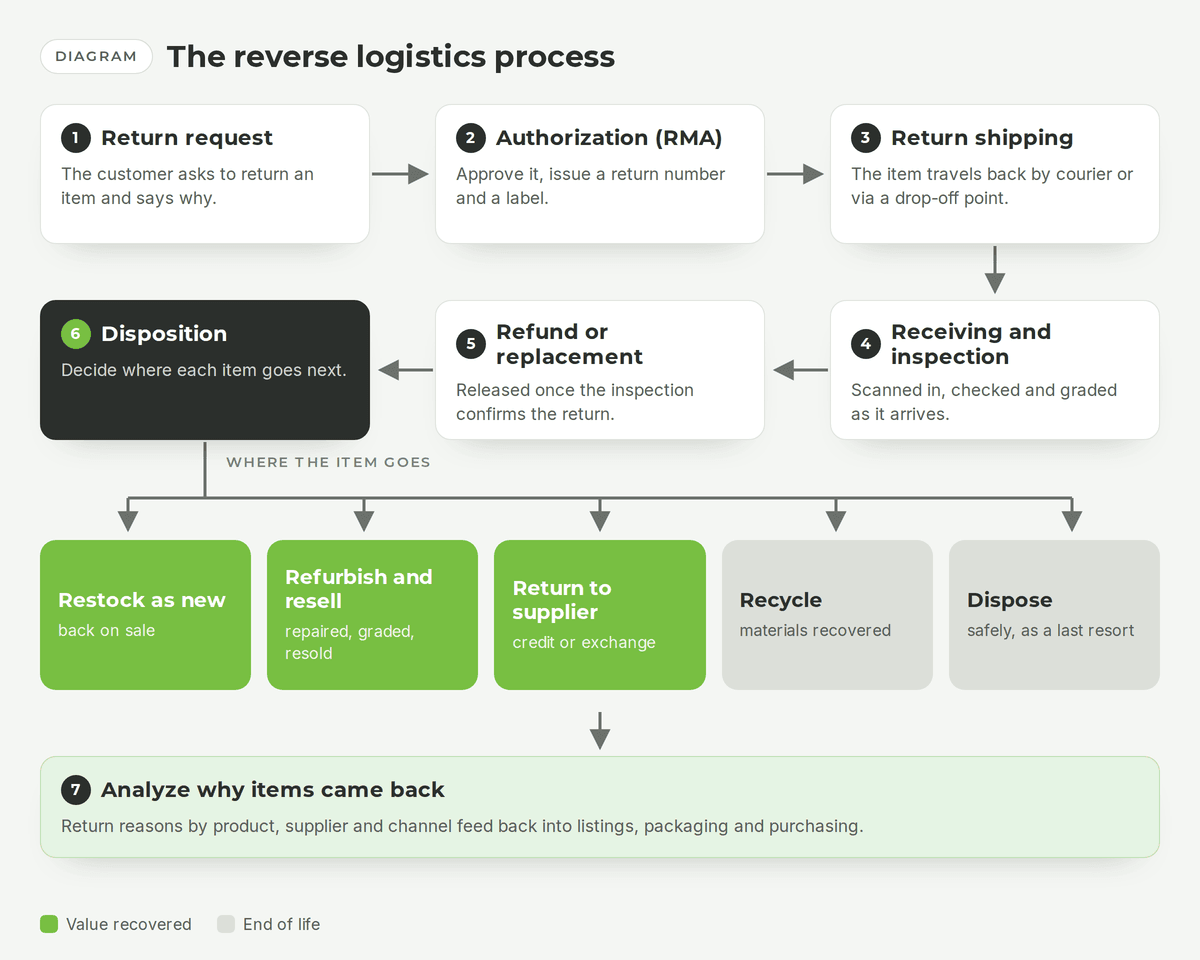
- Return request. The customer asks to return an item and gives a reason. Capture the reason as a choice from a list, not as free text, so you can count it later.
- Authorization. You approve the return and issue a return number (an RMA, return merchandise authorization) and a shipping label. Returns that should not come back, such as cheap items that cost more to ship than they are worth, can be refunded without a return.
- Return shipping. The item travels back by courier or through a drop-off point.
- Receiving and inspection. The return is scanned in against its return number, checked and graded: as new, damaged but repairable, or end of life.
- Refund or replacement. The customer is refunded or sent a replacement once the inspection confirms the return.
- Disposition. You decide where each item goes next: back into stock as new, to refurbishment and resale, back to the supplier for credit, to recycling or, as a last resort, to disposal.
- Analysis. Return reasons by product, supplier and sales channel show what to fix upstream: product descriptions, sizes, packaging or a supplier's quality.
What is the reverse supply chain?
The reverse supply chain is the full set of activities that bring products back from customers and recover their value: collection, inspection, sorting, refurbishment, redistribution, recycling and disposal. Reverse logistics is its operational core: moving, storing and handling the goods on their way back.
Traditional Logistics Versus Reverse Logistics
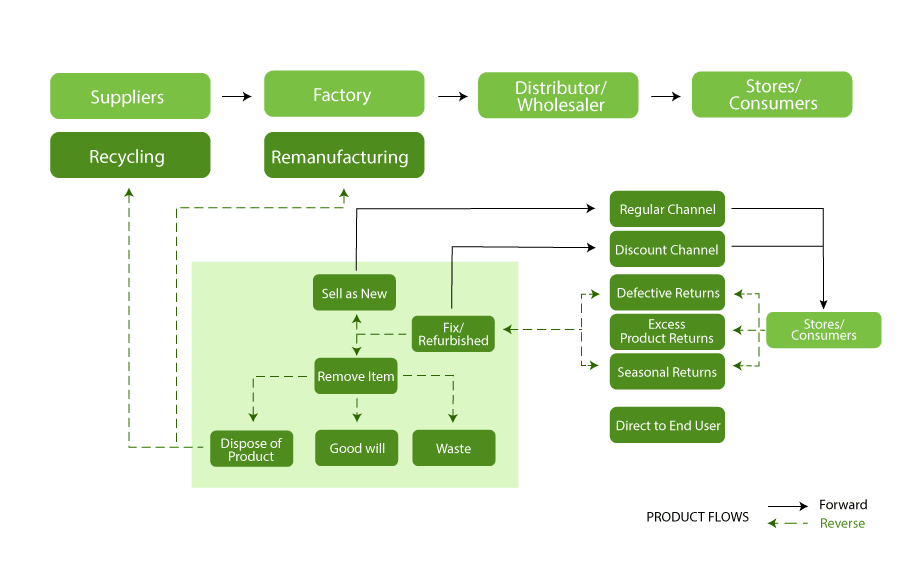
A traditional logistics process flow begins at the supplier, to the factory, distributor, retailers, and ends with customers. Reverse logistics follows the same process backward: begins at the customer and moves counterclockwise to return goods to any location along the supply chain.
Well-planned supply chains can handle some requirements for reverse logistics and are adaptable to changes. Products can be returned using this process either to the original supplier or one step further down the supply chain. Even regular sales or discount channels (like liquidators) can receive returned goods.
Forward and Reverse Logistics Process
In the image below you can follow the traditional logistics process as a straight line and the reverse logistics process as a dashed line.
Types of reverse logistics
Returns management
The most typical reverse logistics procedure for handling routine customer returns is returns management, which should provide a seamless, trouble-free experience to increase customer loyalty and brand image.
Return policy and procedures
All customer returns are evaluated in accordance with this policy, which should be consistently upheld by both clients and staff. It's best to maintain these policies out in the open and simple for customers to access.
Remanufacturing or refurbishment
Reconditioning returned goods avoids businesses and merchants from forgoing profit (or losing money) on flawed goods while reducing unnecessary waste.
Packaging management
In order to cut waste and save money on new packaging for returned items, businesses using package management procedures are able to reuse packaging.
Unsold products
The process of returning unsold products to manufacturers is specifically focused on sending items from end-users or fulfillment centers back to the producers. Delivery rejection, weak sales, or other causes may be involved.
End of service life
When a product reaches the end of its useful life, some must be returned to the manufacturer to properly handle their environmental disposal.
Delivery failure
Products that cannot be delivered are usually sent back to the manufacturer from fulfillment centers, however, efficient businesses may be able to handle delivery failure by fixing the problem and resending the product.
Rental equipment
Products that are rented or leased are returned to the manufacturer at the end of a certain term for disposal, recycling, or redeployment.
Repair and maintenance
Products such as consumer electronics (laptops, for example) may be returned to have repairs or warranty work performed.
Green reverse logistics
Green reverse logistics puts the environmental cost of returns next to the financial one. In practice that means:
- repairing and refurbishing before recycling, and recycling before disposal;
- reusing packaging and returnable containers;
- consolidating return shipments instead of moving single items;
- routing returns to the nearest location that can process them;
- measuring how much of what comes back still ends up in landfill.
Strategies to Optimize Reverse Logistics
Cohesive solutions that take into account speed, efficiency, and cost are required for businesses to maximize reverse logistics. Think about policies, partners, data, capacity, logistics, and transportation before acting. Try the following strategies to improve your reverse logistics:
- Review and revise the procedures related to your company's returns and repairs.
- Collaborate closely with suppliers to ensure a smooth, integrated experience for customers.
- Use data collected on product returns to optimize processes in sales, product design, and forward logistics processes.
- Track products forward and backward so you can easily identify outlier data and selectively recall products instead of entire lines.
- Centralize return centers to efficiently determine how best to reclaim product value
- Regularly review the processes for forward and reverse logistics and transportation to determine where they intersect and save time, money, and trips.
How to measure reverse logistics
| Metric | How to calculate it | What it tells you |
|---|---|---|
| Return rate | items returned ÷ items sold | how often products come back |
| Processing time | days from arrival to disposition | how long recoverable value sits idle |
| Cost per return | total cost of returns ÷ number of returns | what each return costs you |
| Recovery rate | returns restocked or resold ÷ all returns | how much value you get back |
| Top return reasons | returns for each reason ÷ all returns | what to fix upstream |
Where Planograma fits
In Planograma WMS a return is a document of its own, raised on the spot from the handheld like a receipt, and the item goes straight back into stock at a location. Inventory control keeps returned and damaged goods sorted and rotated apart from new stock, and returnable packaging can be tracked with RFID.
Want to see what Planograma could do for your warehouse?
Book a 30-minute walkthrough with a specialist and see the platform running on your own flows.
Book a demo